
When preparing a Will or a Trust, one of the basic questions we confront is how property will be distributed at death. Yet we can never be sure who exactly will survive us to receive our property. Living descendants may predecease us and new family members may yet come into existence. We are invariably planning for an event of uncertain circumstances. Most people will agree that their descendants should be treated equally. Lawyers have therefore developed two general approaches to dividing property “equally” at death.
By Representation
By far the most common distribution scheme calls for property to be distributed “by representation” or “per stirpes.” This means that the property is divided equally into as many shares as there are testator’s then-living children and predeceased children who left surviving descendants. Each then-living child gets his or her share. The shares of the predeceased children are divided equally among their living descendants in the next generation below. This subdivision continues at each succeeding generation. In short, each child gets an equal share, with grandchildren stepping into the shoes of the predeceased children to equally split that share. Here’s an example:
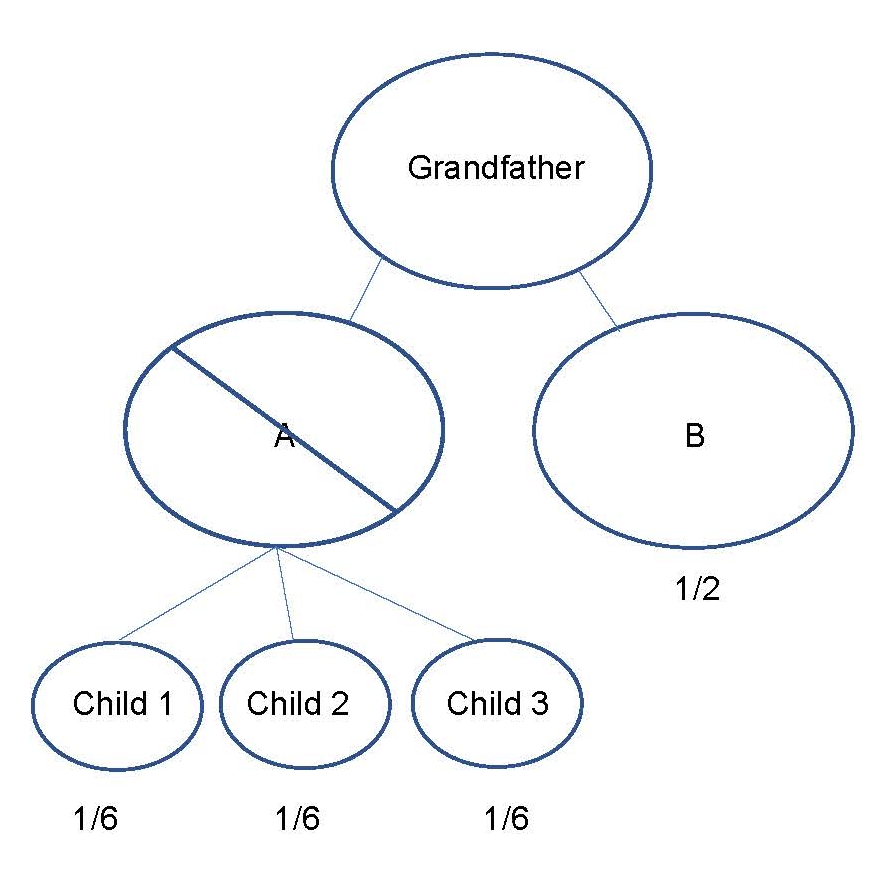
Grandfather has two children, A and B. A has three children. Grandfather dies survived by B and the children of A. Grandfather’s Will provides “I leave all my property to my children, A and B, with right of representation.” Grandfather’s estate is divided into two equal shares: one for A and one for B. B receives his share because he survived Grandfather. A’s share is then further divided equally among A’s own children, who each survived Grandfather. The result is that B takes one-half of the estate, while A’s three children each take one-sixth of the estate.
You can see how distribution by representation assumes that, had all of the testator’s children had survived the testator, those children would have ultimately treated their own children (testator’s grandchildren) equally.
Per Capita
In contrast, a testator may choose to treat all survivors of a generation equally in the sense that their share should not be determined by the number of their siblings. This form of distribution is known as “per capita at each generation.” Like “by representation”, this means that the property is divided equally into as many shares as there are testator’s then-living children and predeceased children who left surviving descendants. Each then-living child gets his or her share. The difference is what happens next. The shares of predeceased children are then recombined and divided equally among the surviving descendants of the predeceased children without reference to the size of the share their parents would have taken. Here’s an example:
Grandmother has three children: A, B and C. B has two children, C has four children. Grandmother is survived by A, B’s two children, and C’s four children. Grandmother’s Will provides “I leave all my property to my children, A, B and C, or to their then-living issue, per capita at each generation.”
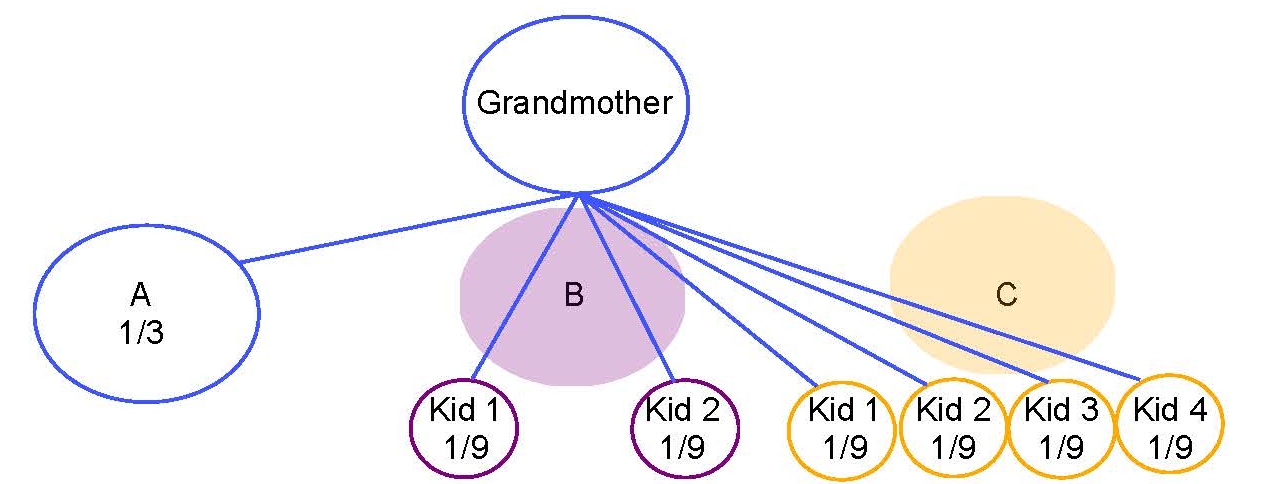
Grandmother’s estate is divided into three equal shares: one for A, one for B, and one for C. A receives her share because she survived Grandmother. The shares for B and C are recombined because they did not survive Grandmother. Those shares are then divided equally among the six surviving children of B and C. The result is that A gets one-third of the estate, and the six grandchildren each get one-ninth of the estate.
Contrast this with a distribution by representation, which would have resulted in A getting one-third, B’s children each getting one-sixth, and C’s children each getting one-twelfth of the estate. In other words, B’s children would have received twice the amount as C’s children. You can see that distribution per capita assumes that surviving takers at each generation should be treated equally and not according to the share their deceased parents would have taken.